
Radiant Red
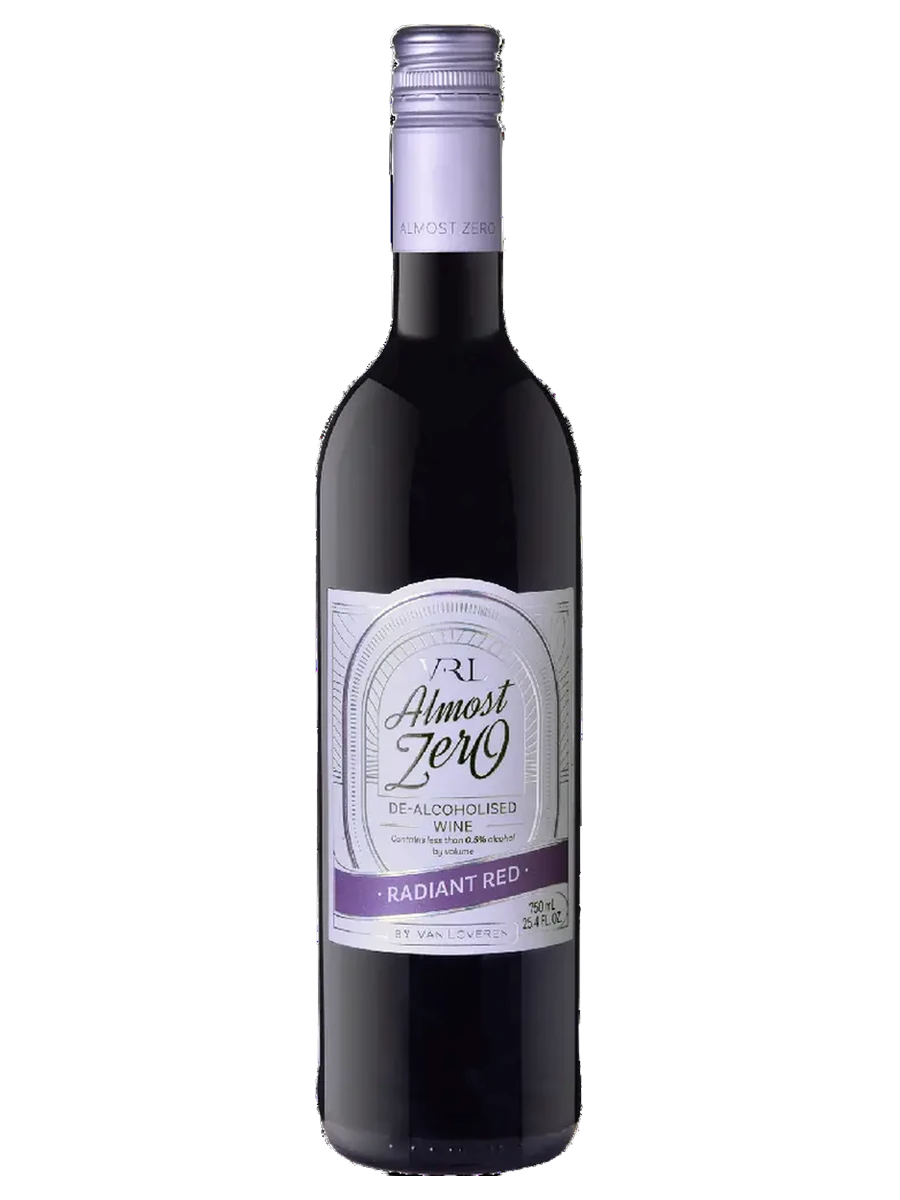
78/100
The short takeRipe plum and black cherry give this Merlot some shape, but the sweetness does the work the missing alcohol would have done. Moderate acidity and light tannin cannot pull it back. Clean and easy, and a little too sweet to convince.
Tasted Karl HillHow we score
Serve Slightly chilled, 54–57°F.
Who it’s for A Merlot only if ripe plum and noticeable sweetness are what you want. It is too sweet to read as a dry red.
Try instead
-
Breakaway Merlot
A higher-scoring bottle in this style
Bergdolt-Reif & Nett Breakaway Merlot sits at 90 in the same style. It has less perceived sweetness and stronger acidity.
Compare -
Organic Red Merlot
A higher-scoring bottle in this style
Lussory Organic Red Merlot sits at 82 in the same style. It has less perceived sweetness.
Compare -
0% Premium Red
A higher-scoring bottle in this style
Giesen 0% Premium Red sits at 81 in the same style. It has less perceived sweetness.
Compare
TDS Wineprint
This pour · documented production
In the glass
- Nose
- Ripe plum and black cherry come first. The fruit smells ripe and clean, and those two notes are the whole of the aroma.
- Palate
- The same plum and black cherry carry the sip, along with noticeable sweetness, moderate acidity, and only light tannin. The fruit is pleasant and gives the wine a little structure. The sweetness feels as if it is standing in for the weight alcohol would have supplied, so the glass turns softer and less balanced than a conventional red.
- Finish
- Clean and simple, and still a little too sweet. The fruit leaves without a dry grip, so the close stays easy to drink and does not quite convince as a red.
Structure and likeness Show Hide
Structure
- Sweetness
- Medium-sweet
- Acidity
- Moderate acidity
- Tannin
- Low tannin
How wine-like is it?
Moderate wine likeness
Separate from the score. A convincing resemblance is not a higher rating.
The fruit sits in a wine register. The balance does not: sweetness fills the gap left by the alcohol, and the profile stays softer than a conventional red.
The wine
Sweetness is carrying this red. The plum and black cherry are ripe and pleasant, and that fruit does give the glass a little structure, but the sugar sits ahead of it. Moderate acidity is present. Light tannin is present. Neither one has the leverage to hold the sweetness in place, so the wine drinks softer and less balanced than a conventional Merlot.
The fruit is not a costume. Plum and black cherry taste like the fruit of a red wine, which is why the sweetness is frustrating rather than merely sweet. It covers a glass that was already doing some of the work. The substitution is easy to taste: sugar standing in where alcohol and a firmer tannin would have kept the fruit in line.
What remains is clean and simple. It is easy to finish, and it is a little too sweet to feel like the red the fruit is promising. That softness is the flaw. Pour it when you want dark fruit without a dry red’s bite. The tannin never takes the glass over. The last impression matches the first: ripe fruit, then sugar, then a softness a Merlot with its alcohol still in it would not have had to borrow.
78 sits below the median of the 220 dealcoholized wine bottles we've tasted.
How to drink it
The rest of the serving note.
Show
Hide
Slightly chilled, 54–57°F. The back label says refrigerate after opening or store below 39°F.
The bottle
Show
Hide
Research notes
The Almost Zero Merlot page calls this Radiant Red and says it is 100% Merlot, with alcohol at 0.33% and sugar at 25 g/L. It describes mulberry and does not name a removal machine. Van Loveren’s range page puts the line at 0.3% and says the wines are made by traditional winemaking plus de-alcoholization. wine.co.za lists the same 0.33% alcohol, Robertson, 750 ml, and a screwcap, with residual sugar at 4.7 g/L. The tasting paragraph on that wine.co.za page describes a Sauvignon Blanc and is not used. Front and back both print de-alcoholised wine and less than 0.5% alcohol by volume. The nutrition panel is 114 calories, 13 g total sugars, and 7 g added sugars per 12 fl oz (355 ml) serving, about 2 servings per container. A marketing line on that label mentions mulberry and does not name a removal machine.
Where to buy
- Almost Zero Merlot
- Van Loveren Almost Zero range
- Package
750 ml
$11.99 (Total Wine; Mix 6 for $10.79 each)
- Also listed
- Almost Zero Merlot · Producer
- Van Loveren Almost Zero range · Producer
- Availability
Total Wine ($11.99; Mix 6 $10.79), Pick n Pay South Africa, Van Loveren (DTC)
Availability is market-specific; a producer link does not establish shipping to every country. Prices and availability are independently observed and may change. Retailer listings do not imply endorsement. A different package is labeled as a different format. Reader-service exceptions and commercial links are identified above; neither affects scores, rankings, classification, verification, or editorial coverage.
Product facts
- Producer
- Van Loveren Family Vineyards
- Origin
 Robertson, South Africa
- Residual sugar
- 25 g/L
- Bottle / can
- 750 ml (25.4 fl oz)
Sources disagree on ABV and Sugar. Send a correction
Sources & verification
Show details
Hide details
Source links leave this site and open in a new tab.
Where sources disagree
Sources disagree on the following points.
- ABV: The displayed residual is the Merlot page’s 0.33%.
- Sugar: The displayed sugar is the producer page. The figures are not averaged or converted.
Evidence at a glance
- Bottle verified5 facts
- Producer documented3 facts
- Secondary source1 fact
- Retailer sourced1 fact
- Unverified2 facts
Production record
2 core facts remain to be documented or rechecked.
- Classification
- Verified
- Method
- Undeclared
- ABV
- Exact declaration
- Origin
- Documented
- Record
- Has open discrepancy
Sources
-
Bottle / can label Bottle label
- Volume
- Country
- Ingredients
- Calories
- Barcode (EAN/GTIN)
Note
- Barcode (EAN/GTIN)
- Barcode recorded from packaging or producer listing
-
Note
- Method
- Van Loveren range page is the producer source. It does not name a removal machine.
-
Note
- Price
- Shelf price is the Total Wine figure supplied with this record. wine.co.za identifies the SKU.
Product record history Sourced changes and open disagreements. Prior claims stay on the record when sources conflict.
- ReviewedReviewed and published.
- UpdatedCatalog record updated from sourced research.
- OpenDiscrepancyABV and Sugar.
Structure
Closest by structure
-
Cabernet Sauvignon
79
same structure profile
Compare -
Blanc
79
same structure profile
Compare -
Shine Zero
80
same structure profile
Compare
Taste
Want something drier?
-
2024 Tuscan Syrah
Andreina 2024 Tuscan Syrah has less perceived sweetness and stronger acidity.
Compare -
Cabernet Sauvignon
Be Well Cabernet Sauvignon has less perceived sweetness and stronger acidity.
Compare -
Pinot Noir
DIVIN Pinot Noir has less perceived sweetness and stronger acidity.
Compare