
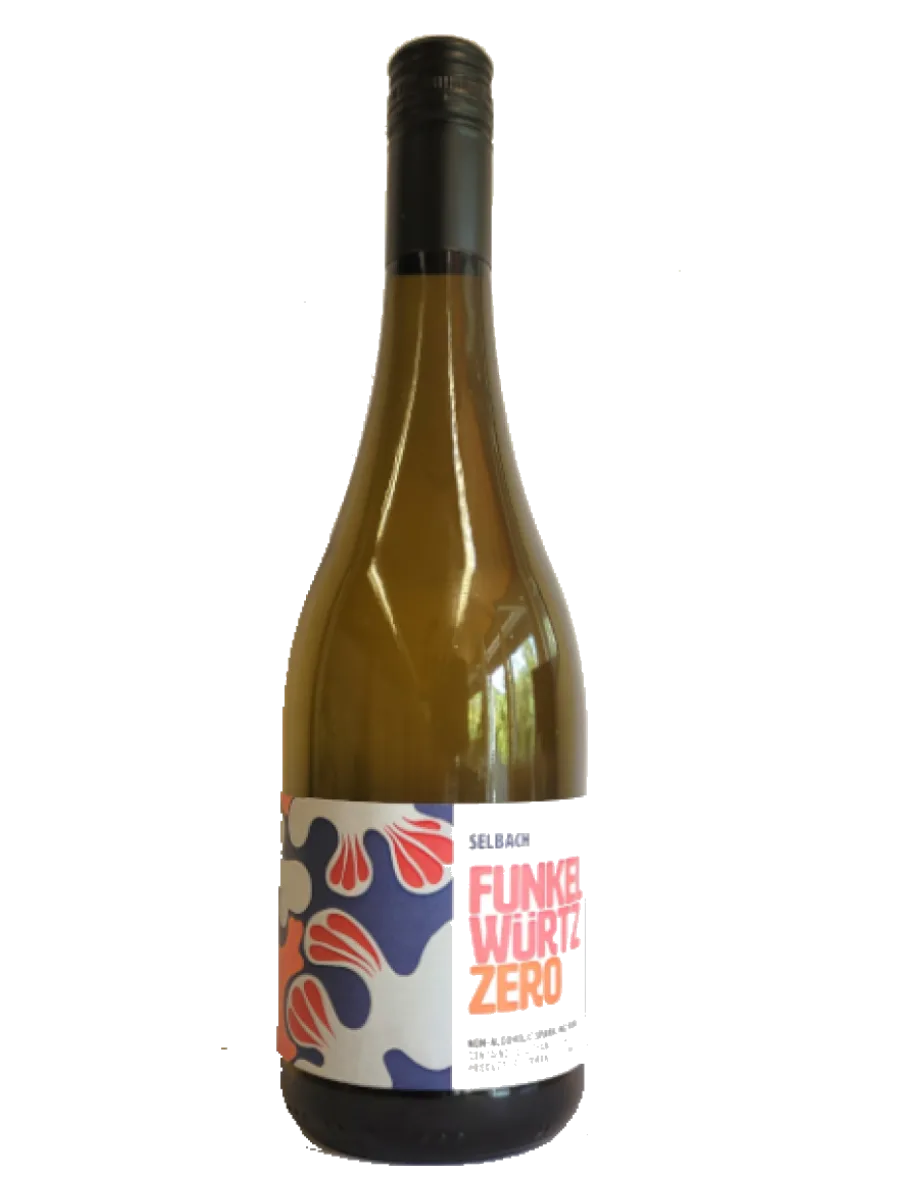
Funkelwürtz Zero
83/100
The short takeFragrant apple and white peach, rounded sweet fruit and a gentle sparkle make an approachable glass. Lively acidity supports the sweetness and keeps the light-bodied palate fresh.
Tasted Karl HillHow we score
Serve 6–8°C (Selbach wine sheet, 2026).
Who it’s for An easy sparkling white when apple, peach, and a gentle prickle should carry noticeable sweetness.
Try instead
-
0.0% Sparkling
A higher-scoring bottle in this style
¡Hola! 0.0% Sparkling sits at 87 in the same style. It has a fuller body.
Compare -
Blanc de Blanc
A higher-scoring bottle in this style
Jörg Geiger Blanc de Blanc sits at 87 in the same style. It has more carbonation.
Compare -
Sparkling Cuvee
A higher-scoring bottle in this style
Edenvale Sparkling Cuvee sits at 86 in the same style. It has a fuller body.
Compare
TDS Wineprint
This pour · documented production
In the glass
- Appearance
- Pale straw yellow, showing a gentle sparkle.
- Nose
- Red apple and white peach lead the aroma, accompanied by floral notes and a subtle mineral impression.
- Palate
- Citrus and orchard fruit give the light-bodied palate its fruit-forward character. Noticeable sweetness rounds the fruit, while lively acidity and a gentle prickle of carbonation provide a fresh counterpoint.
- Finish
- Citrus and light mineral notes carry through a refreshing close. Fruit persistence and any lingering sweetness remain unconfirmed.
Structure Show Hide
- Acidity
- Bright acidity
- Body
- Light body
- Carbonation
- Light spritz
The wine
The sweetness is noticeable in Selbach Funkelwürtz Zero, giving its citrus and orchard fruit a rounded impression. Lively acidity and a gentle prickle of carbonation supply the freshness, while the body stays light. That combination makes for an approachable glass: the fruit leads, with acidity and sparkle giving the palate definition.
Red apple and white peach provide the aromatic center, with floral notes adding interest and a subtle mineral impression behind the fruit. The pale straw-yellow pour shows a gentle sparkle. Citrus joins the orchard fruit on the palate, continuing the fragrant, fruit-forward character without changing the light weight of the wine.
Citrus and light mineral notes carry into a refreshing close; fruit persistence and any lingering sweetness still need confirmation. Fragrant fruit, noticeable sweetness and a light sparkle account for the wine’s easy drinkability. Fresh acidity matters to that appeal, lifting the rounded fruit and keeping the overall impression lively. Its strengths lie in the combination of aroma, fruit and freshness.
83 is typical of the 25 dealcoholized Sparkling bottles we've tasted.
The bottle
Show
Hide
Research notes
Acidity about 6.0 g/L. CO2 pressure about 2.5 bar.
Where to buy
No producer purchase link on file.
- Package
750 ml
$19.99 (Amanti Vino, observed 2026-10-16); Plum Market sale listing $18.99, regular $23.00
- Also listed
- Amanti Vino
- Availability
Listed by U.S. retailers including Amanti Vino and Plum Market; local availability not independently checked.
Availability is market-specific; a producer link does not establish shipping to every country. Prices and availability are independently observed and may change. Retailer listings do not imply endorsement. A different package is labeled as a different format. Reader-service exceptions and commercial links are identified above; neither affects scores, rankings, classification, verification, or editorial coverage.
Product facts
- Origin
 Mosel, Germany
- Grapes
- 80% Muskateller, 20% Rivaner
- Residual sugar
- about 75 g/L
- Base beverage
- wine
- Bottle / can
- 750 ml
Sources disagree on Method. Send a correction
Sources & verification
Show details
Hide details
Source links leave this site and open in a new tab.
Where sources disagree
Sources disagree on the following points.
- Method: Selbach’s process plan names vacuum distillation at about 31°C and 50 millibar, with aroma recovery in a second column. The column is not taken above 38°C. Cross-flow filtration at 0.25 µm follows, and no artificial flavors are added. Skurnik says the finished wine goes to a facility that removes the alcohol with membrane technology.
Evidence at a glance
- Bottle verified13 facts
- Producer documented2 facts
- Retailer sourced2 facts
- Unverified5 facts
Production record
One core fact remains to be documented or rechecked.
- Classification
- Verified
- Method
- Named method
- ABV
- Ceiling declaration
- Origin
- Documented
- Record
- Has open discrepancy
Sources
-
Bottle / can label Bottle label
- ABV
- Ingredients
- Grape blend
- Nutrition
- Importer
- Package
- Volume
- Country
- Production
- Base beverage
- Grapes
- Identifiers
- Barcode (EAN/GTIN)
7 notes
- Grape blend
- Physical U.S. bottle reads 80% Muskateller and 20% Rivaner; the current Skurnik page independently matches that blend.
- Nutrition
- Per 150 ml: 70 calories, 11 g carbohydrate, 11 g total sugar, 0 g added sugar, 1 g protein, 0 g fat and 0 mg sodium. The 2026 wine sheet lists about 7.5 g carbohydrate per 100 ml, which sits with that panel.
- Importer
- Imported by Skurnik Wines, New York, NY. Shipped by J&H Selbach, 54492 Zeltingen, Germany.
- Package
- 750 ml; lot 09103; best by 08/2027.
- Country
- Physical front label prints Product of Germany.
- Production
- Physical front label reads De-alcoholized Sparkling Wine.
- Barcode (EAN/GTIN)
- Barcode recorded from packaging or producer listing
-
Producer Producer
- Method (sources disagree)
Note
- Method
- The plan names ATW as the receiving plant.
-
Producer Producer
- Residual sugar
Note
- Residual sugar
- The photographed U.S. label lists 11 g total sugar and 0 g added sugar per 150 ml. The process plan allows sweetening on request with sugar, grape must, or rectified grape must concentrate, and does not say which, if any, this cuvée used.
-
Note
- Price
- Amanti Vino blocked automated access and was not rechecked.
Product record history Sourced changes and open disagreements. Prior claims stay on the record when sources conflict.
- ReviewedReviewed and published.
- UpdatedCatalog record updated from sourced research.
- Fact corrected · Method facetCorrected from membrane-filtration to vacuum-distillation. Selbach’s process plan names vacuum distillation at about 31°C and 50 millibar, with aroma recovery in a second column. The column is not taken above 38°C. Cross-flow filtration at 0.25 µm follows, and no artificial flavors are added. Skurnik says the finished wine goes to a facility that removes the alcohol with membrane technology.
- OpenDiscrepancyMethod.
Structure
Closest by structure
-
Rosé
83
same structure profile
Compare -
Sauvignon Blanc
83
same structure profile
Compare -
0.0% White
83
same structure profile
Compare
Production
Compare another production approach
-
Elderflower & Yuzu Verjus
Glasrose Elderflower & Yuzu Verjus is an alternative. This bottle is dealcoholized by vacuum distillation.
Compare -
Salinger
Dry Wit Salinger is an alternative. This bottle is dealcoholized by vacuum distillation.
Compare -
Prosecco NV
San Mon Prosecco NV is an alternative. This bottle is dealcoholized by vacuum distillation.
Compare
83/100